Pensions – an overview
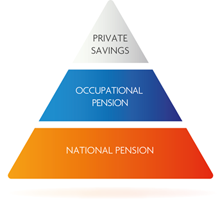
Your retirement pension consists of three main components: the national state pension, the collectively agreed occupational pension and any private pension savings. Private savings will not be discussed in detail here.
Both the state pension and the occupational pension are paid in by your employer when your salary is paid.
State retirement pension
Your state pension is calculated based on your income, usually income from employment, but also income you have received in the form of unemployment benefit, sickness and activity benefits and parental allowance. Scholarships are not counted as pensionable income.
The state pension has two components: income pension and premium pension. The premium pension, which is the smaller of the two parts, is invested in funds, and you are able choose which funds it is invested in yourself. You can read more about this at Fondkollen (in Swedish) and on the website of the Swedish Pensions Agency.
Occupational pension
To be eligible for an occupational pension, you must be employed by an employer that has a collective agreement. Only employees can earn occupational pension. If you have a scholarship, you are not an employee and therefore do not earn occupational pension.
State sector employees
As a state sector employee, you are covered by the PA 16 state sector occupational pension agreement.
Section 1
This part of the PA 16 agreement applies to employees who were born in 1988 or later. It is a defined contribution pension and consists of three components: the elective part, Kåpan Tjänste and Kåpan Flex. You can decide yourself how the elective component is invested.
You accrue occupational pension until the age of 69. A total of 6 per cent of your salary is set aside up to a ceiling of 7.5 income base amounts. If your salary is higher than the equivalent of 7.5 income base amounts, your employer pays in more for any salary above this level. You can read more about Section 1 of the PA 16 agreement here.
Section 2
This part of the PA 16 agreement applies to employees who were born before 1988. It comprises three defined contribution components: the elective part, Kåpan Tjänste and Kåpan Flex. A total of 6 per cent of your salary is set aside.
If you were born before 1973 or were born after 1973 and have a salary above 7.5 income base amounts, you also have a defined benefit retirement pension.
Payments to your defined contribution pension can be made in until you reach the age of 69. The defined benefit pension is calculated until you reach the age of 65. You can read more about Section 2 of the PA 16 agreement here.
Please note that for employees born in 1965 or earlier, special rules apply, which you can read about here.
Regardless of your year of birth, you are also entitled to receive a disability pension if you are no longer able to work due to a long-term illness, as well as a survivor's pension, which provides compensation to your family in the event of your death.
If you have an individual agreement with your employer regarding supplementary pension contributions, (salary sacrifice), these additional pension contributions are included in the elective component. For more information, please the website of the National Government Employee Pensions Board (SPV).
You can find more information about the PA 16 occupational pension agreement at SPV.se. There you can also see how much your employer pays into your pension each month (in Swedish), for State sector employees only.
Improved pension agreement from 2024 for employees born before 1988
Saco-S, (of which SULF is a member), has signed an agreement with the Swedish Agency for Government Employers regarding improvements to the PA 16 pension agreement for employees in the state sector. The agreement covers all state higher education institutions, as well as Chalmers University of Technology and Jönköping University. The agreement came into force on 1 January 2024. The two most important changes are that
- contributions to your pension are higher due to the addition of a flexible pension contribution, and
- you continue to earn defined contribution pension if you work until the age of 69. (Until 2024, the maximum age was 65.)
The contribution to the flexible pension is 1.5% of salary for employees born in 1966 or later, and 0.5% of salary for those born in 1965 or earlier. To compensate for the difference, employees born in 1965 or earlier will continue to be entitled to apply for partial retirement from the age of 61. The accrued flexible pension can either be used to reduce working hours in the years leading up to full retirement or added to the future pension, which will then be higher than it would otherwise be. For more information, please see the Saco-S website (in Swedish).
Employees in the municipal and regional sectors
If you are employed by a municipality or region, you can find information about your retirement pension on the website of the Swedish Association of Local Authorities and Regions (SKR) (in Swedish).
Employees in the private sector
If you work in the private sector, you can find information about your retirement pensions at avtalat.se. Please note that in order to be covered by the agreement, the place where you work must have a collective agreement.
Your future pension
It is never too early to start planning for your financial situation when you retire, and in the higher education sector it is important to know how different forms of funding, for example scholarships, affect your future pension. If you would like to see a forecast of your retirement pension level, you can log in to minpension.se (in Swedish).
If you have any questions about your state sector occupational pension, we recommend that you contact the National Government Employee Pensions Board (SPV). For questions about your national state pension, you should contact the Swedish Pensions Agency.